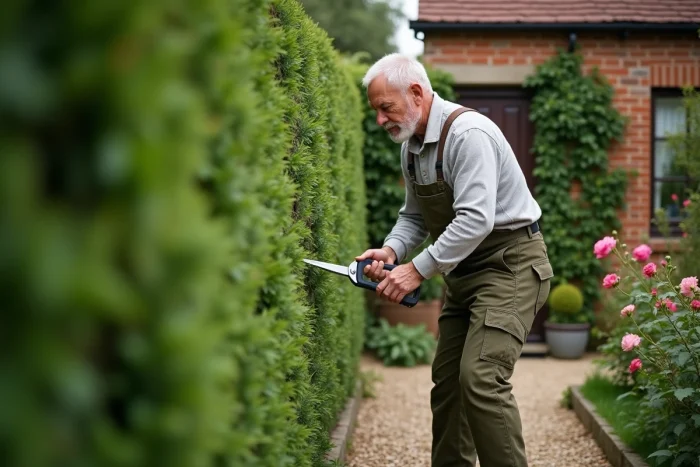
The size of a hedge structures a garden as much as it reveals it. Between regulatory constraints related to wildlife protection, the choice of species adapted to climate change, and techniques of plant sculpting, this practice involves skills that go far beyond the simple annual hedge trimming.
Hedge trimming and nesting: the regulatory framework to know
Since the Climate and Resilience Law of August 2021, local authorities and state services have been insisting on the prohibition of trimming hedges, trees, and shrubs during the nesting period. In practice, this period runs from March 15 to July 31 in most of the territory.
This constraint does not only concern the agricultural sector. Awareness campaigns from prefectures and municipalities, relayed since 2022, specify that intensive trimming in spring can be penalized, including for rural hedges in residential areas, under the protection of natural habitats.
An amateur gardener trimming their privet hedge at the end of April risks destroying active nests of blackbirds, robins, or warblers. The safest period for a thorough trim is between September and February, when the birds have left their nests and the sap is down. Several online resources, such as sculpte-haie.com, detail trimming calendars adapted to each species to respect these constraints.

Climate-resilient hedges: which species to trim less often
Guides published by the French Office for Biodiversity and certain regions since 2022 highlight local species resistant to drought. Bloodtwig dogwood, hazel, viburnum lantana, and medlar are among the recommended shrubs for creating hedges that withstand heat waves without additional watering.
This orientation marks a turning point from monotypic hedges of thuja or cherry laurel, which are water-intensive and require multiple trims per year. A hedge composed of varied local species is trimmed less frequently, as its growth remains moderate and its naturally irregular shape is part of its aesthetic.
Free hedge or trimmed hedge: a choice that commits to maintenance over the years
The free hedge, partially left to its natural development, promotes ecological corridors and provides more shade. It requires one to two interventions per year, mainly to control branches encroaching on public pathways or neighboring properties.
The strictly trimmed hedge (boxwood, hornbeam, yew) requires at least two annual passes, sometimes three to maintain clean lines. The choice between these two approaches depends as much on the desired style as on the time available for maintenance.
- Free hedge of local species: one trim at the end of summer and a possible rebalancing in winter is sufficient in most cases.
- Semi-formal hedge (hornbeam, beech): two trims per year, in June (outside the critical nesting period) and in September.
- Topiary hedge (boxwood, yew): a minimum of three passes, with regular touch-ups to maintain geometry.
Topiary art and ornamental trimming: practical techniques to go beyond the rectangle
Topiary art, which dates back to ancient Rome and has seen a revival since the Renaissance gardens, involves sculpting plants into geometric or figurative shapes. The most accessible shapes remain the sphere, cone, and pyramid.
For a beginner, the sphere on boxwood is a good entry point. The technique is based on a simple principle: first trim an equatorial band at the desired height, then gradually round from the top and bottom towards this midline. A wire template placed around the plant helps control regularity.
Species suitable for plant sculpting
Not all species lend themselves to ornamental trimming. So-called evergreen plants, with persistent foliage and dense growth, yield the best results.
- Boxwood: a historical reference in topiary art, it tolerates frequent trimming and maintains a sharp shape for several weeks.
- Yew: slower than boxwood, it accepts severe trims and even regrows on old wood, which forgives mistakes.
- Privet: fast-growing and dense foliage, but requires more frequent interventions to maintain a precise shape.
- Holly: underutilized, it offers shiny foliage and good tolerance to trimming, with the added benefit of feeding birds in winter thanks to its berries.
Trimming tools: manual shears or hedge trimmer, the right gesture according to the plant
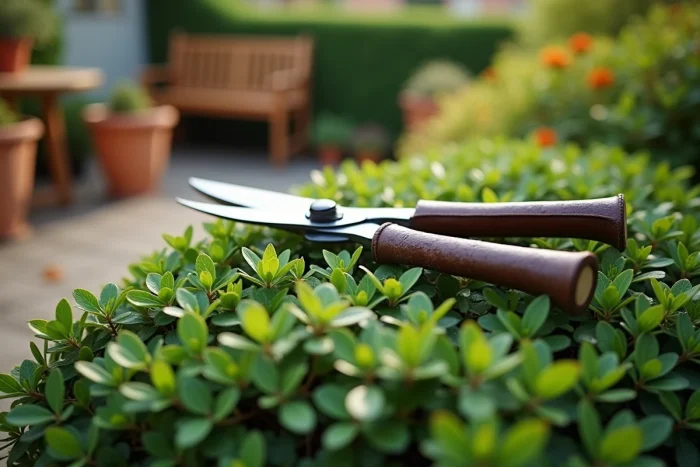
The choice of tool determines the quality of the cut as much as the gesture. Manual shears produce a cleaner cut than an electric hedge trimmer, as they slice the leaf rather than tearing it. On large-leaved species like cherry laurel, this difference is noticeable: leaves cut in half by a hedge trimmer turn brown at the edges, giving a neglected appearance for several weeks.
For long or tall hedges, the hedge trimmer (electric, battery-operated, or gas) remains the only realistic choice in terms of time. The key lies in sharpening: dull blades crush stems instead of cutting them, which promotes fungal diseases.
A final point often overlooked concerns disinfecting the blades between different shrubs. Transitioning from a sick plant to a healthy one spreads pathogens (boxwood blight, hornbeam powdery mildew). A cloth soaked in 70° alcohol between each shrub limits this risk.
Hedge trimming sits at the intersection of routine maintenance and the aesthetic expression of a garden. The regulatory calendar now imposes a rhythm that many gardeners were not used to respecting, while repeated drought episodes push for a reconsideration of species choices. Adapting one’s actions to these realities allows for maintaining hedges that are both healthy, habitable for wildlife, and visually well-kept.