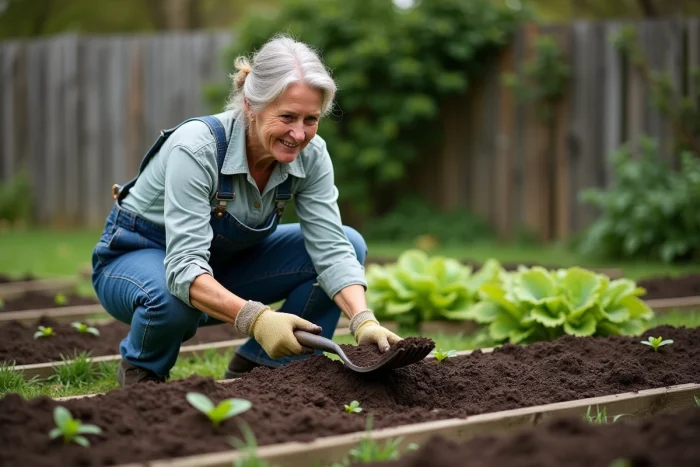
Manure remains one of the oldest organic amendments, but its use on lawns raises questions that the vegetable garden does not. A closely mown lawn does not react like a deep cultivated soil: the exposure surface, the risk of burning, and pathogen management change radically. Understanding these specifics before spreading anything avoids damage that can sometimes take a long time to correct.
Composted manure or pellets on lawns: what municipalities have already tested
Articles aimed at amateur gardeners almost always talk about manure in the vegetable garden. In fact, the most documented feedback on lawns comes from municipalities and sports clubs. Football fields, golf courses, and municipal green spaces use composted solid manure or pelletized manure to nourish their lawns, partially replacing synthetic fertilizers.
The choice between pellets or mature compost is not trivial. On a closely mown lawn, fresh manure presents three simultaneous problems: it contains viable weed seeds, it can carry pathogens, and its ammoniacal nitrogen content varies unpredictably. Pellets, on the other hand, have undergone a thermal treatment that eliminates most of these risks while allowing for precise dosing per square meter.
Several experiments conducted as part of the reduction of synthetic inputs (the European “Farm to Fork” strategy) show that a partial substitution with composted manure maintains a dense lawn, with slightly slower growth. This slowdown in growth reduces mowing frequency without degrading the visual appearance, a side effect that many homeowners would welcome.
Before choosing a product, it is possible to find out how to use manure in the garden with Bricotage and understand the differences between raw and processed forms.
Burn risk on lawns during hot periods: an underestimated problem
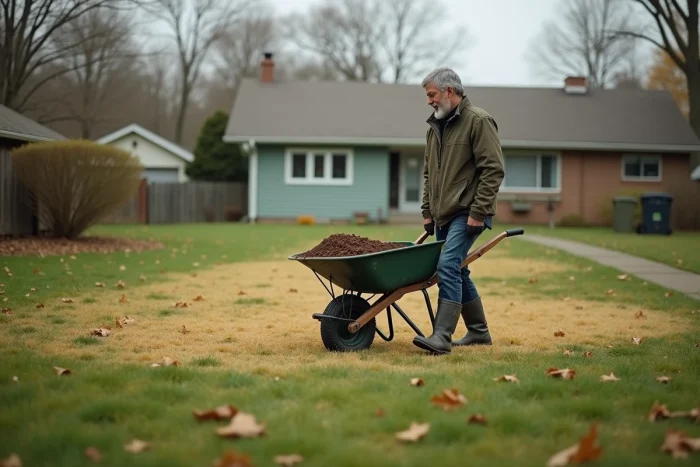
Comparative tests conducted on ornamental lawns reveal that manure, even well-composted, causes more lawn burns during hot periods than slow-release organo-mineral fertilizers. The phenomenon worsens in two specific situations:
- Spreading occurs just before a dry spell, without rinsing irrigation in the hours that follow
- The soil is superficially dry at the time of application, which concentrates nitrogen on the surface in direct contact with the blades
- The layer of manure remains in clumps rather than being spread thinly, creating localized overdosing areas
In practice, this means that autumn and early spring remain the safest windows for applying manure on lawns. Spreading in the middle of summer, even with mature compost, exposes the lawn to cumulative stress (heat, lack of water, localized excess nitrogen) that yellows the affected areas within days.
The reflex to adopt: always water generously after spreading to dilute soluble elements and move them below the root surface. Without this watering, the organic matter remains in prolonged contact with the leaves and causes necrosis.
Fresh manure in the vegetable garden: slugs, weeds, and nitrogen hunger
In the vegetable garden, fresh manure retains its value for reviving the biological life of tired soil. Field reports published by organic farmer networks emphasize a point that popular guides downplay: uncomposted manure increases slug and weed pressure during the first two years of regular use.
Seeds of unwanted plants survive the digestive transit of cattle and horses. They germinate massively in the spring following spreading, which necessitates additional weeding. Composted or vermicomposted manure limits these effects because the temperature rise of the pile (beyond 60 °C in well-managed composting) destroys the majority of seeds.
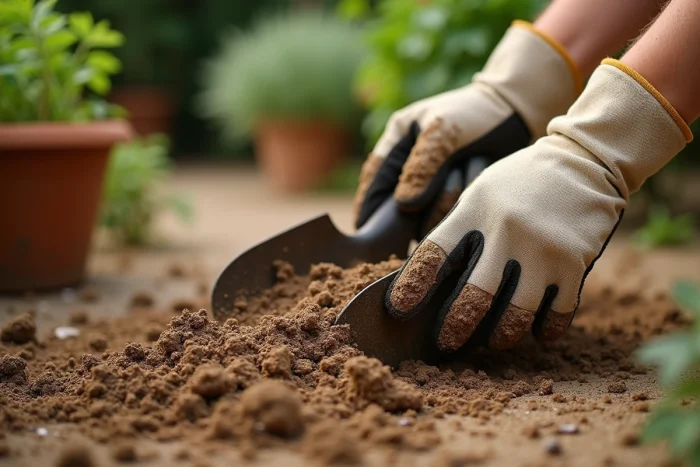
The infamous “nitrogen hunger” also deserves a concrete explanation. When strawy, still partially decomposed manure is incorporated into the soil, the microorganisms that break down cellulose consume the available nitrogen for their own metabolism. Neighboring plants become temporarily deficient, exhibiting characteristic yellowing of the lower leaves. This phenomenon lasts from a few weeks to a few months depending on the carbon/nitrogen ratio of the manure used.
Spreading schedule and dosage according to use: lawn or vegetable garden
The schedule differs significantly between lawns and vegetable crops. Here are the benchmarks that emerge from documented practices:
- On lawns, autumn is the most suitable period: composted or pelletized manure decomposes during the winter and nourishes the lawn as it resumes growth in spring, without the risk of heat-related burning
- In the vegetable garden, an application of fresh manure is considered in autumn to allow the material to transform on-site during the cold season, with a thin layer protected by mulch
- A spring application is only feasible with well-composted manure, to avoid nitrogen hunger during the peak growth phase of seedlings
- On heavy clay soils, horse manure (more strawy and aerated) improves drainage, while cattle manure is better suited for light and sandy soils that lack water retention
Dosage remains a delicate point. The available data do not allow for a single rule as manures vary in composition depending on the animal, diet, type of bedding, and degree of composting. The prudent approach is to start with a thin layer and observe the soil’s reaction over a season before increasing quantities.
On lawns, excessive application is more visible and more damaging than in the vegetable garden: burnt grass takes weeks to regenerate, whereas a vegetable can be replaced. It is better to have two light applications (autumn and then late winter) than a single massive spread.
Manure is not a precision fertilizer. It is an amendment that works over the medium term by improving soil structure, water retention capacity, and microbial life. Expecting spectacular results from the first application often leads to overdosing, with the burning and weed problems already mentioned. Regular moderate applications, season after season, yield better results than a one-time heavy load.