
A Tassimo machine that only fills the cup halfway poses a common problem for users of Bosch pod coffee makers. This phenomenon affects both recent models and machines that have been in service for several years. Several causes, often combined, explain this reduced coffee volume, and most can be resolved without technical intervention.
Reading the T DISC barcode: the least suspected cause of small Tassimo coffees
Before disassembling anything, the first check concerns the pod itself. Each T DISC carries a barcode that the machine reads to determine the water volume, temperature, and brewing time. A warped T DISC or a dirty reader skews the dosage without triggering an error light.
A Tassimo espresso intentionally produces less liquid than a long coffee. If the volume seems low, first check that the pod corresponds to a long recipe. Testing another intact pod allows for a quick decision: if the volume returns to normal, the problem lies with the previous capsule or the reading window.
Clean the reading window (the small glass area in the disc holder) with a soft, slightly damp cloth. Dried coffee or milk residues can gradually accumulate there and interfere with the barcode reading. To resolve a Tassimo issue related to drink volume, this simple step eliminates a common cause without complex manipulation.
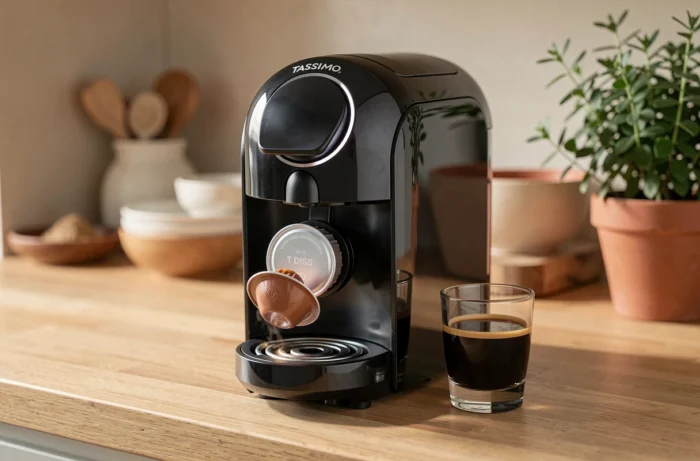
Limescale in the water circuit: Tassimo descaling and thermal diagnosis
Limescale remains the most documented cause of reduced flow in Tassimo coffee makers. The water heated for each preparation gradually deposits limescale in the internal circuit, pump, and outlet nozzle. The flow decreases, and the volume in the cup follows suit.
A often overlooked clue helps confirm this hypothesis: a coffee that comes out both short and less hot indicates limescale buildup in the circuit. If the temperature remains normal but the volume is low, the barcode or reservoir issue deserves priority exploration.
Effective descaling of the Bosch Tassimo coffee maker
The “calc” or spray light comes on when the machine detects a need for descaling, but waiting for this signal means that limescale has already reached a significant level. Regular descaling, before the light appears, better preserves the flow.
- Use the service T DISC (the yellow disc provided with the machine) and a compatible Tassimo descaling tablet or solution. Place the service T DISC in the disc holder, pour the solution into the water reservoir, and start the descaling program.
- Let the complete cycle run without interruption. The liquid must circulate throughout the circuit to dissolve the accumulated limescale deposits in the pump and internal conduits.
- Then rinse the reservoir and run two cycles with clear water to eliminate any chemical residue before preparing a drink.
If the flow does not improve after descaling, a second cycle may be necessary on heavily scaled machines. Descaling does not target milk residues, which require separate cleaning.
Milk drink residues: a buildup that descaling does not resolve
Cappuccino, latte, or hot chocolate lovers expose their machine to a type of buildup different from limescale. Dried milk deposits around the disc holder and perforation area reduce the flow of the drink. These residues, greasy and sticky, resist standard descaling.
Cleaning involves removing the disc holder (removable on most Bosch Tassimo models) and washing it with soapy hot water. Inspect the perforation holes: a toothpick can dislodge solidified deposits without damaging the plastic. A rinse with the service T DISC after each milk drink greatly limits this buildup.

Water reservoir and float: mechanical checks on the Tassimo machine
The reservoir plays a less obvious role than it seems in the volume of coffee obtained. On Tassimo models equipped with a float, it indicates to the machine the available water level. A float stuck in the low position (due to limescale or debris) signals an empty reservoir when it is full, prematurely interrupting the preparation.
Remove the reservoir, empty it completely, and check that the float moves freely. Soaking it in warm vinegar water for about twenty minutes may be enough to free a stuck float. Replace the reservoir securely: improper positioning prevents the machine from correctly detecting the water level.
Resetting the Tassimo coffee maker
When none of the previous causes resolve the issue, resetting the machine may restore the original settings. The procedure varies by Bosch Tassimo models, but it generally involves holding down the start button for several seconds while the machine is off before turning it back on.
This action resets the descaling counter and any potential shifts in internal parameters. It does not replace physical maintenance (descaling, cleaning the disc holder) but usefully complements mechanical operations.
When the problem persists despite coffee maker maintenance
If the coffee volume remains insufficient after descaling, cleaning the disc holder, checking the float, and testing with a new pod, the machine’s pump may have lost power. Pump wear manifests as a quieter noise at startup and an abnormally long preparation time.
For this type of failure, replacing the pump is technically possible but rarely cost-effective on entry-level models. Newer Bosch Tassimo models incorporate more accessible pumps, making it easier for a specialized repair technician to intervene.
Diagnosis by elimination remains the most reliable method: pod, then barcode reader, then descaling, then float, then reset. Each step eliminates a cause and points to the next, preventing the replacement of an expensive part for a simple limescale issue.