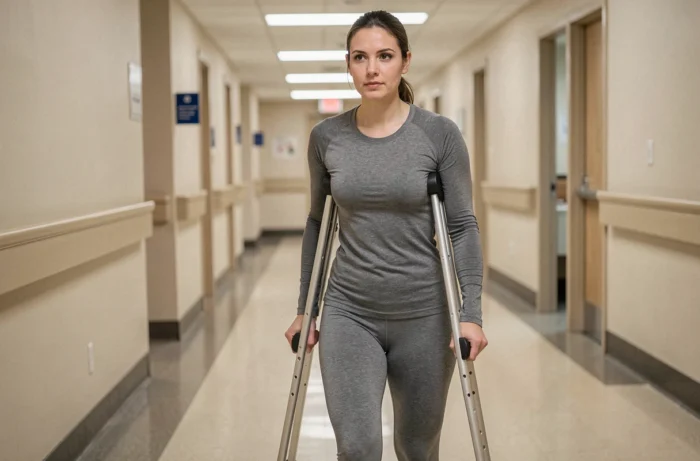
Leaving the hospital with a pair of crutches and no clear instructions on walking technique is the daily reality for many patients. You find yourself on the sidewalk, arms already aching, improvising a shaky rhythm that tires the back and undermines recovery. These ten tips cover the points that make the difference between smooth rehabilitation and weeks of painful compensation.
1. Properly adjust the height of the crutches
Before even taking a step, check the adjustment. The handle should reach the height of the wrist crease when the arm hangs down by the side, with the elbow slightly bent. An adjustment that is too high pushes the shoulders towards the ears and compresses the nerves in the armpit. Too low, it forces you to lean forward and overloads the lower back.
On axillary crutches, the upper support should be placed a few centimeters below the armpit, never in direct contact with it. To learn how to walk correctly with crutches, this initial adjustment conditions everything else: posture, endurance, and safety.
2. Maintain an upright and balanced posture
The natural reflex is to lean on the crutches to relieve the injured leg. You end up hunched over, looking at the ground, with trapezius tightness by the third day. Keeping the torso upright protects the back and breathing.
A practical cue: imagine a string pulling the top of your head upwards. The shoulders remain low and relaxed. Keep your gaze ahead, not on your feet, which also improves balance and obstacle detection.
3. Distribute weight between the arms and the healthy leg
A common mistake is to suspend all your weight under the armpits. Prolonged pressure on the brachial plexus can cause persistent numbness in the hands, a signal that requires contacting the healthcare team. The push should be on the palms, not under the arms.
Transfer weight through the handles by gripping moderately. The healthy leg supports the load on the ground, while the arms provide propulsion and lateral stability. The effort should remain distributed: if the wrists burn, slow down and adjust your grip.
4. Master the step-by-step movement technique
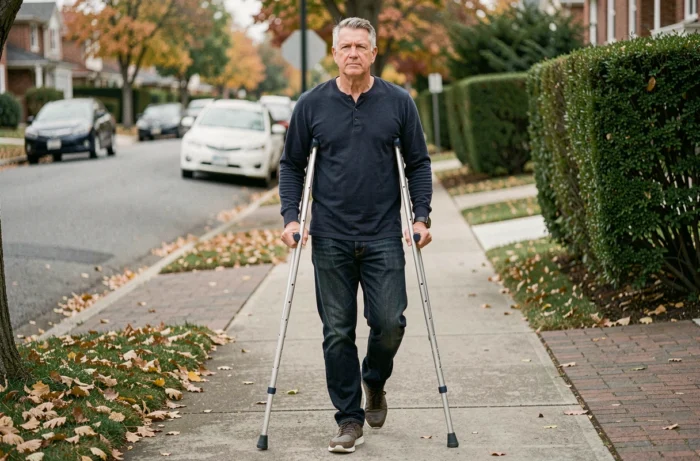
The weight-bearing instruction prescribed by the doctor determines the technique. “No weight,” “contact weight,” “partial weight,” and “weight as tolerated” do not correspond to the same sequence of movements. This instruction should be clarified before walking, climbing stairs, or going out.
For movement without weight using two crutches, the basic sequence is as follows:
- Advance both crutches simultaneously a small step in front of you.
- Transfer weight onto the handles by pushing with the palms.
- Swing the healthy leg forward, between or slightly beyond the crutches.
- Stabilize the position before starting the cycle again.
Each step remains short. Aiming for the natural amplitude of a normal stride creates a forward imbalance that increases the risk of falling.
5. Strengthen the muscles of the arms and upper body
Walking with crutches engages muscle groups that are rarely used in daily life: triceps, deltoids, finger flexors. After a few days, arm fatigue limits mobility more than the injury itself.
Simple exercises (wall push-ups, tricep extensions with a water bottle, squeezing a foam ball) are enough to maintain endurance. Starting strength training in the first week reduces cumulative fatigue and facilitates longer outings.
6. Avoid sudden movements or twists
A sharp turn on a crutch pivots the healthy knee and can create a sprain on the only functioning leg. Turn in small steps, never by rotating the body around a fixed support.
Slippery surfaces (wet tiles, polished wood floors, unsecured rugs) amplify the risk. On wet ground, further reduce the stride length and check that the tips grip. The reflex to catch oneself in case of imbalance should remain controlled: letting go of a crutch to hold onto a piece of furniture is better than a violent twist of the torso.
7. Use crutches with ergonomic handles
Standard hard plastic handles concentrate pressure on a narrow band of the palm. After several hundred meters, blisters and carpal tunnel pain can appear. Ergonomic handles made of gel or high-density foam distribute the load over a wider surface.
Feedback varies on this point depending on hand morphology, but most patients who switch to an anatomical handle report a noticeable reduction in fatigue. The additional cost is modest compared to the comfort gained over several weeks of rehabilitation.
8. Gradually increase the distance walked
On the first day, aim for the hallway. In the first week, the block around the building. Doubling the distance all at once because you feel good one morning is the best way to end up exhausted halfway, with no bench nearby.
Increasing walking distance in regular increments allows muscles and joints time to adapt. A good indicator: if pain or fatigue persists for more than an hour after walking, the distance was too long.
9. Protect the contact areas of the crutches
Rubber tips are often a neglected factor in falls. A worn, cracked, or wet tip can slip suddenly, especially on tiles or stairs. Checking their condition before each use takes a few seconds and can prevent a serious fall.
- Check the wear of the non-slip surface at least once a week.
- Replace a tip as soon as it shows cracks or a smooth flat surface.
- Add handle protections (foam sleeves) if the grip becomes painful.
10. Consult a physiotherapist for guided learning
A few sessions are enough to correct posture defects and learn technical gestures: climbing stairs (the healthy leg goes up first), descending (the crutches go down first), sitting, and standing up safely. A physiotherapist also adapts the technique to the type of weight-bearing prescribed.
Crutches should not serve as a standalone treatment for balance disorders. For someone who primarily uses them because they are unstable, they can mask the problem. Supervised work on strengthening and balance remains the foundation for safe and sustainable walking recovery.
Some symptoms require quickly contacting the healthcare team rather than adjusting your technique alone: falling, persistent numbness in the hands, increasing pain, significant swelling, or changes in the color of the injured limb. When used and adjusted correctly, crutches remain a reliable tool, provided that autonomy is not confused with improvisation.