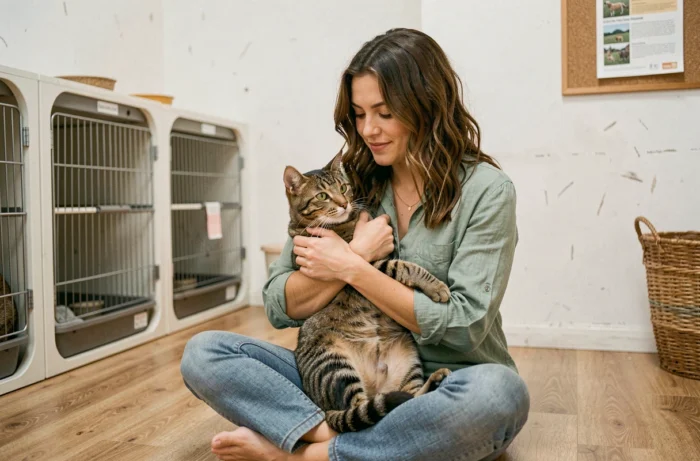
French shelters welcomed approximately 280,000 cats in 2025, accounting for 72% of the animals taken in according to the national study by the SPA and the Affinity Foundation published in September 2026. More than 45,000 cats were turned away due to lack of space. Adopting a cat is a long-term commitment, and the choice of feline companion is based on criteria that aesthetic preferences alone cannot cover.
Saturation of Shelters and Profile of Cats Available for Adoption
Half of the cats taken in by shelters in 2025 were kittens under six months old. However, the facilities host a wide variety of profiles, including many young and sociable cats.
Adult cats, often arriving after being abandoned due to a move or an unwanted litter, make up the majority of the population that stagnates in shelters. Their behavior is already stabilized, and their socialization is known. For a first-time adopter, an adult cat whose temperament is documented by the shelter significantly reduces the risk of incompatibility with the household.
It is possible to consult the Ado PCJE website for cats to identify available profiles in different facilities before visiting.
Kittens, on the other hand, are adopted quickly. Their adoption does not pose placement difficulties for the associations. However, adopting a kitten means accepting a longer adjustment period, unpredictable behavior, and close veterinary follow-up during the first months.
Commitment Certificate and Reflection Period: The Legal Framework for Cat Adoption
Since the law against animal cruelty, any acquisition of a cat (free or paid) requires the signing of a commitment certificate and knowledge of the species’ needs. This document must be provided to the future adopter at least seven days before the actual transfer.
This reflection period is not a formality. It aims to prevent impulsive adoptions, which directly feed the cycle of abandonment. The certificate details the physiological, behavioral, and environmental needs of the cat.
On the shelter or association side, adoption conditions generally include a pre-adoption home visit, verification of identification by microchip, and sterilization of the animal before transfer. Registered breeders apply similar procedures, with a sales contract that also commits the buyer to the future living conditions of the animal.
Sterilization and Responsible Adoption: The Numbers That Matter
The study by the SPA and the Affinity Foundation highlights a clear finding: the vast majority of cats abandoned directly to associations were not sterilized. For cats coming from pounds, the proportion is even higher. These data establish a direct link between lack of sterilization and the risk of abandonment.
Unwanted litters are the primary cause of shelter saturation. The peak of abandonments occurs in spring and summer, the active breeding period for unsterilized cats. A cat adopted without prior sterilization, especially if it has access to the outdoors, mechanically contributes to this cycle.
Serious shelters systematically provide a sterilized animal. Field reports vary on this point when it comes to transfers between individuals or through online classifieds, where sterilization is not always performed before the cat is handed over.
What Sterilization Covers at the Time of Adoption
- The surgical procedure itself, performed before the animal is handed over by most associations and accredited shelters
- The reduction of the risk of urinary marking and escape in males, and the elimination of unplanned litters in females
- A long-term health benefit, as sterilized cats are less exposed to certain reproductive pathologies according to current veterinary data
Choosing Between Shelter, Breeder, and Individual: Concrete Decision Criteria
The choice of adoption channel alters the nature of guarantees and the profile of accessible cats. The three main options (shelter or association, registered breeder, individual) are not equivalent on several points.
- In a shelter, the cat is identified, vaccinated, sterilized, and its behavior has been observed in a group. The adoption fees cover these veterinary actions and remain well below the actual cost of care
- With a breeder, the buyer accesses a specific breed with documented pedigree. The price generally includes initial vaccinations, identification, and sometimes sterilization. The kitten’s behavior remains to be discovered in its future environment
- Between individuals, the situation is the most variable. No obligation for prior sterilization systematically applies, and the commitment certificate is sometimes unknown or circumvented
For a household with children or other pets, the shelter offers a concrete advantage: volunteers know the cat’s reaction to social stimuli. A cat described as “sociable with children” by an association that has housed it for several weeks provides more reliable information than an eight-week-old kitten whose temperament is not yet formed.
Litter, Environment, and Health: Preparing the Home Before Arrival
Preparing the home is as crucial to the success of the adoption as the choice of cat. One litter box per cat (plus one extra), elevated areas, a scratching post, and a quiet retreat space are the minimum requirements. A cat stressed by its environment develops behavioral issues, which are the second leading cause of return to shelters after unwanted litters.
The first veterinary visit should take place within days of adoption to check the general health status, update vaccinations if necessary, and establish a follow-up record. This appointment also allows for questions about diet, deworming, and potential outdoor access.
Adopting a cat is a commitment for an average of fifteen years. SPA data shows that the current saturation of shelters results less from a lack of adopters than from a lack of preparation beforehand. Taking the time for the commitment certificate, verifying sterilization, and adapting one’s home: these are all concrete checks that limit returns to the shelter.