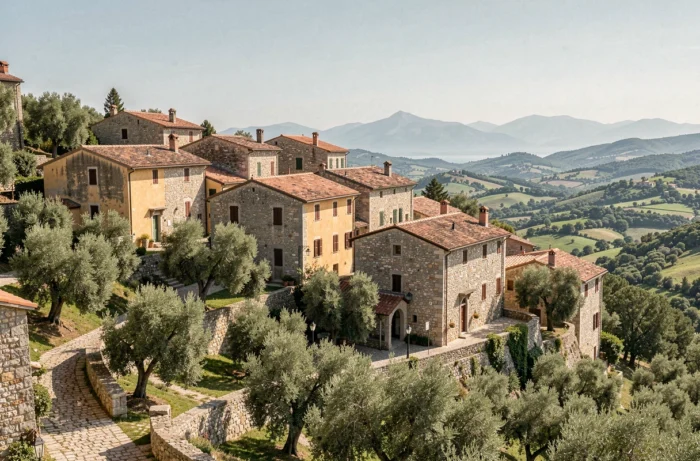
Casinca packs a built heritage into a narrow strip between the coastal plain and the ridges of Haute-Corse, with a density that surprises even those who know the island well.
Pisan churches, villages clinging to schist slopes, and chestnut groves that still shape the agricultural landscape: the area reads like a condensed history of rural Corsica, from the medieval period to recent intercommunal investment. The inauguration of new community offices in Vescovato on 10 October 2024, for example, reflects a shared momentum in a region that remains inhabited year-round.
Religious buildings in Casinca: a Romanesque and Baroque heritage to explore methodically
Casinca’s religious architecture stands out for the coexistence of two stylistic periods that are rarely so clearly visible across such a small area. The Romanesque chapels, inherited from Pisan influence, feature carefully laid stonework and apse vaults that can be spotted as you approach the hamlets.
Baroque churches, often built onto older foundations, add polychrome façades and gilded altarpieces. Loreto-di-Casinca, Penta-di-Casinca and Vescovato are home to the finest examples. Finding these buildings means exploring the narrow streets on foot: vehicle access often ends below the village centre.
Practical information on access, opening hours and community events is available at https://www.casinca.fr, a useful resource when planning a route between the villages.
Hilltop villages in Casinca: routes between Vescovato, Venzolasca and Loreto
Each village in Casinca occupies its own defensive plateau, facing a different direction depending on the valley it once watched over. This setting creates strikingly varied microclimates and views from one village to the next.
Vescovato, a former episcopal seat, has a denser urban layout than its neighbours. Its vaulted passageways and tower houses reflect an administrative role that lasted into the modern era. Slightly higher up, Venzolasca offers open views across the eastern plain and the Tyrrhenian Sea.
Loreto-di-Casinca is worth a longer stop. The village hosted the fourth edition of the travelling Castagniccia-Casinca festival from 16 to 18 May 2025, with workshops devoted to rural heritage, literature and local creativity. The festival turns village squares into places where culture is shared and passed on, rather than simply serving as a backdrop for visitors.
Getting between villages on foot or by car
The departmental roads linking these villages are narrow and winding. Walking between neighbouring villages rarely takes more than an hour, provided you can find the mule tracks that are still passable. Some sections are not signposted, so an IGN 1:25,000 map remains the most reliable guide.
- Vescovato to Venzolasca: a short route along a path above the plain, accessible year-round except during unusually heavy snowfall.
- Venzolasca to Loreto-di-Casinca: a longer route through chestnut terraces, with a moderate elevation gain.
- Loreto to Penta-di-Casinca: a shaded trail through dense woodland, best tackled during the cooler hours in summer.
Fire risk in Casinca: adapt your outings to seasonal guidance
Wildfire prevention directly affects access to Corsica’s hinterland during the summer. In Casinca, maquis vegetation and chestnut groves provide abundant fuel when rainfall drops.
The community of municipalities has installed water reserves (tanks and bladders) in several villages to strengthen the resources available to emergency services. This measure reflects how seriously local officials take the risk, and it’s important to plan accordingly before setting out on a hike.
What to check before each outing
Between June and September, the Haute-Corse prefecture publishes a daily risk level for each mountain area. When the risk is high, some trails and forest tracks may be closed to the public, including those linking Casinca’s hilltop villages.
- Check the prefectural bulletin the day before or on the morning of your outing, not the week before: risk levels can change quickly.
- When the hinterland is closed, choose coastal routes or villages accessible by paved road.
- Do not park on DFCI tracks (Defence of Forests Against Fire), even if they appear to be open: they must remain clear for emergency vehicles.
- Reschedule a woodland loop for a day when the mistral has died down rather than pushing ahead: fines apply, and the risk is real.
Chestnut groves and agricultural landscapes: what Casinca retains of its traditional economy
The chestnut grove is more than just a hiking backdrop. In Casinca, as in neighbouring Castagniccia, chestnut trees shaped food, housing and land use for centuries. The cultivation terraces still visible beneath the forest canopy point to intensive use of the land, quite different from the apparent abandonment suggested by today’s vegetation.
Several orchards are still maintained by local growers who produce chestnut flour. Meeting these producers at a village market in autumn offers a way to understand the landscape that a monument-focused visit alone cannot provide.
Casinca is more than a list of monuments. It is a region where buildings, vegetation and climatic conditions form a coherent whole. Planning visits around the seasons and wildfire risk is not an optional precaution; it is essential for reaching the hinterland and discovering what makes it so distinctive.