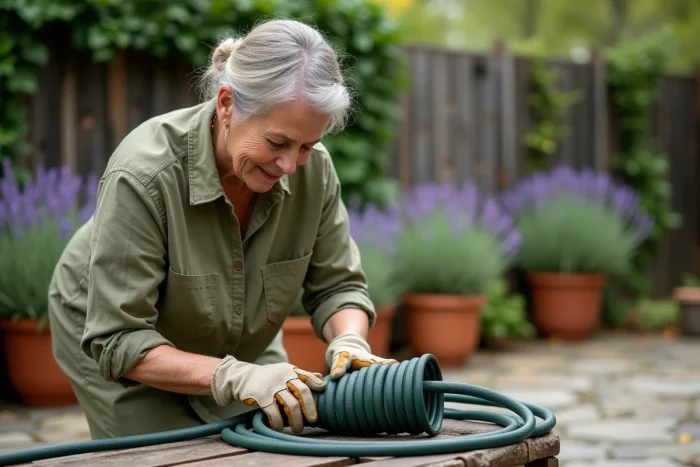
An expandable hose left out in the rain for a week ends up swelling unevenly, and the internal latex cracks well before the end of the season. This type of hose requires a different maintenance routine than a standard hose, precisely because its double-walled structure (inner latex, outer fabric) reacts poorly to stagnant moisture and prolonged bending.
Drying and draining the expandable hose before storage
We tend to turn off the tap and let the hose retract on its own. The problem is that water gets trapped in the folds of the inner latex. On a sunlit terrace, this stagnant water heats up and accelerates the degradation of the material.
The most reliable method is to disconnect the hose from the tap and elevate the connection side for a few minutes. This allows the residual water to drain by gravity from the other end. A quick pass of the hand along the hose, from top to bottom, helps to push out the last pockets of water.
To check that the drainage is complete, gently shake the retracted hose: if it feels heavy or you hear sloshing, you need to repeat the process. This action takes less than two minutes and significantly extends the lifespan of the latex. Gardeners report a reduced lifespan of nearly one-third in humid areas when drainage is not done systematically.
For more information on maintenance practices suitable for this type of hose, you can consult the advice from Le Jardin d’Emilie that details each step.
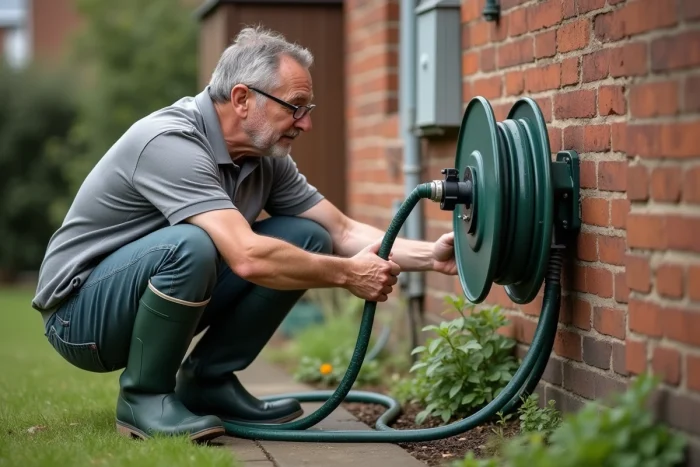
Storing the expandable hose: wall reel or ground basket
The choice of storage support is not trivial for an expandable hose. Unlike a rigid standard hose, a retracted expandable hose is compact and lightweight, but it is sensitive to residual moisture and crushing.
Rotating wall reel for balconies or small spaces
On a balcony or narrow terrace, a rotating wall reel is the most suitable solution. The hose remains suspended, protected from the wet ground, and air circulates around it. A technical guide from Leroy Merlin highlights the superiority of this option over ground baskets for urban balconies, particularly to avoid moisture accumulation and accidental falls.
The reel should be mounted at hip height for easier handling. You need to ensure that the support can bear the weight of the hose filled with water, even though in theory, you store the empty hose. Forgetting this can happen quickly.
Basket or bin on the ground for gardens
In a garden with a ground water source, a slatted basket will do the trick. The ventilation through the walls prevents mold. Avoid closed plastic bins, which trap condensation.
- Choose a basket with a perforated or slatted bottom so that residual water does not stagnate under the hose
- Never place the hose directly on a concrete slab heated by the sun, as the heat deforms the retracted latex
- Store the hose in wide, loose loops, without compressing or bending it at sharp angles
Connected expandable hoses: protect the sensors of smart irrigation systems
Some expandable hoses are now integrated into irrigation systems controlled by voice assistants compatible with HomeKit or Alexa. A flow meter or moisture sensor attaches between the tap and the hose connector. These electronic components pose a specific problem for storage.
A wet stored sensor risks oxidation of the contacts, even if the casing is advertised as waterproof. Waterproofing standards (often IPX4 or IPX5) protect against splashes during operation, not against prolonged immersion in the residual moisture of a poorly drained hose.
The procedure to follow before storing the connected hose:
- Disconnect the sensor or connected module from the connector before draining the hose
- Wipe the metal contacts of the sensor with a dry cloth
- Store the electronic module separately, in a dry place (not in the hose basket)
- Check the sensor’s battery at the end of the season to avoid electrolyte leakage during winter
Feedback varies on this point: some users leave the sensor in place all season without issues, while others experience malfunctions after a few weeks of humidity. Disconnecting the module after each use remains the safest precaution when investing in a connected system.
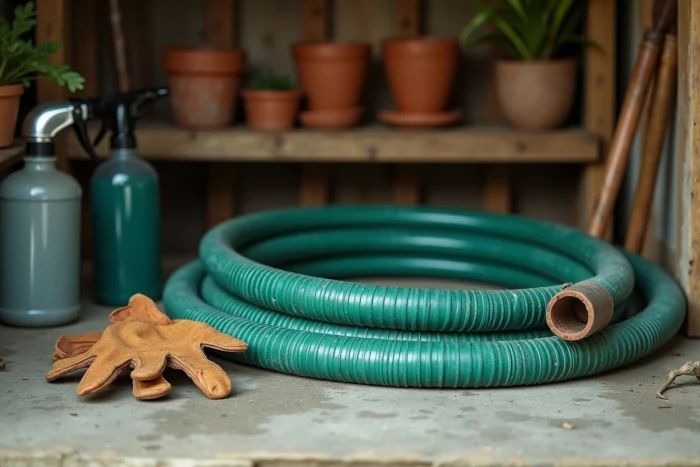
Winter protection and common mistakes with expandable hoses
Frost is the main enemy of an expandable hose. Residual water in the latex freezes, expands, and creates invisible micro-cracks. The following spring, the hose leaks for no apparent reason as soon as it is pressurized.
Completely drain the hose before the first frosts is not optional. Disconnect the hose, let it drain by gravity, then leave it retracted in the open air for an hour before storing it indoors. A garage, cellar, or closed garden shed is suitable, provided the temperature does not drop below freezing.
Three mistakes that shorten the life of an expandable hose
The first: leaving the hose under pressure when not in use. The latex remains stretched permanently and loses its elasticity. Turn off the tap and open the nozzle to release the residual pressure before storing.
The second: storing the hose in direct sunlight. UV rays degrade the outer fabric and weaken the latex. Storing in the shade, even in summer, makes a difference over several seasons.
The third: pulling on the still-retracted hose to reach a distant flowerbed. First, turn on the water to allow the hose to extend, then guide it. Forcing a retracted expandable hose damages the internal seams at the connections.
A well-drained, stored dry, and UV-protected expandable hose can last several seasons without losing elasticity. The routine consists of three actions: drain, dry, store flat in a ventilated container. Nothing complicated, but it’s the consistency that makes the difference.