
Cash payment on Uber Eats regularly raises questions, especially in France where the platform does not offer this option. What payment methods are actually available depending on geographical areas, and what alternatives exist for users without a bank card? This guide compares the available options and analyzes the gaps between markets.
Cash on Uber Eats: Comparative Table by Geographical Area
The availability of cash payment directly depends on the country. Uber Eats adapts its payment methods to local habits, which creates marked disparities between markets.
| Area | Cash Accepted | Digital Payment | Local Wallets |
|---|---|---|---|
| France | No | Yes (CB, Apple Pay, Google Pay, PayPal) | No |
| India | Yes | Yes | Yes |
| Latin America (several countries) | Yes | Yes | Yes |
| United States | No | Yes | Yes (Cash App Pay) |
| Canada | Yes (certain cities) | Yes | No |
In France, cash payment is not offered on Uber Eats. The platform requires electronic payment for each order. In contrast, in countries where a significant portion of the population remains unbanked, cash is sometimes the only means to access the service.
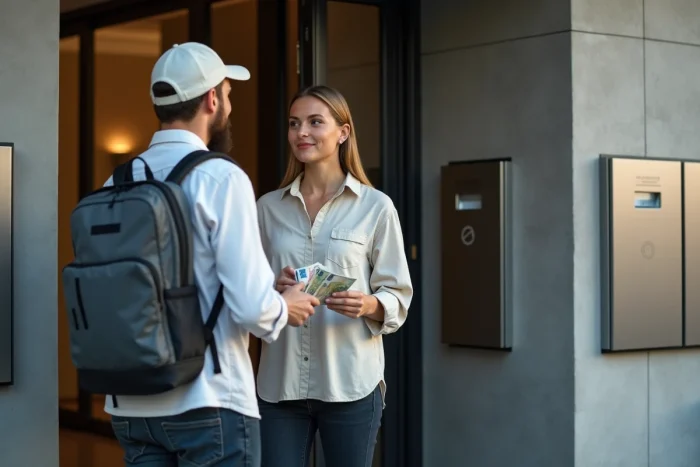
For those who want to understand in detail how to order and pay in cash on Uber Eats in areas where this option exists, the process goes through the app’s wallet, under the “Cash” section.
Electronic Wallets and Prepaid Cards: The Hybrid Alternative to Cash
Competing content presents the choice between cash and credit card as binary. The reality is more nuanced. Uber promotes the integration of local electronic wallets that act as a bridge between cash and digital payment.
In the United States, Cash App Pay allows users to load cash into a wallet at partner retail locations, then use that balance directly on Uber Eats. This principle replicates the mechanism of reloadable prepaid cards.
How the Cash-to-Digital Circuit Works
- The user goes to a physical partner (store, kiosk, tobacco shop depending on the country) and deposits cash onto an electronic wallet or prepaid card
- This balance can then be used on Uber Eats like any other digital payment method, without requiring a traditional bank account
- Traceability is maintained on the platform side, which eliminates the logistical constraints related to handling cash by delivery drivers
In France, this hybrid solution has not yet been deployed by Uber Eats. No local cash-rechargeable wallet is currently integrated into the app for the French market. Users without a bank card must resort to prepaid Visa or Mastercard cards purchased at a tobacco shop, then register them in the app as a standard payment method.
Uber One and Delivery Fees: Why the Payment Method Matters Less Than the Subscription
The debate around cash payment obscures a rarely discussed parameter: the actual cost of an Uber Eats order depends less on the payment method than on the pricing structure applied.
The Uber One subscription combines ride-hailing and Uber Eats and reduces service and delivery fees for regular orders. For a user who orders several times a month, this reduction weighs more on the total bill than the choice between cash and card.
What Uber One Changes in the Calculation
Without a subscription, delivery and service fees accumulate with each order. With Uber One, these fees decrease, sometimes even leading to free delivery beyond a certain order amount.
In countries where cash payment is accepted, the amount handed to the delivery driver includes these fees. The cash-paying customer pays the displayed price without benefiting from pricing optimization related to a subscription, since Uber One requires a digital payment method for the monthly charge. Cash payment therefore mechanically excludes access to this discount.

Risks for the Delivery Driver: What Cash Payment Concretely Implies
When a market allows cash, the operational burden shifts to the delivery driver. Several scenarios documented by feedback from couriers illustrate the frictions.
- Customer absent at the time of delivery: the driver cannot collect payment, the order is canceled via the app, and a charge is applied to the customer’s account on their next order
- Counterfeit bill or insufficient amount: the driver refuses the delivery, reports the incident in the app, and the customer’s account may be blocked
- Change management: Uber specifies that the driver is not required to provide change if the customer does not provide the exact amount, leading to recurring disputes
These constraints partly explain why Uber Eats limits the deployment of cash payment to markets where demand structurally justifies it. In France, the high banking rate makes this option a low priority for the platform.
The choice of payment method on Uber Eats primarily depends on the geographical area. For the French market, reloadable cash-prepaid cards remain the only bridge between cash and online ordering, while awaiting a possible integration of hybrid wallets.