
Stage 1 engine remapping involves modifying the software of a vehicle’s electronic control unit (ECU) to extract more power and torque. No mechanical parts are changed: only the software mapping is rewritten.
This intervention attracts both drivers seeking responsiveness and those hoping to reduce their fuel consumption. Before taking the plunge, it’s better to understand what is really happening under the hood, and especially what the law and insurers think about it.
What the ECU manages (and what we ask it to change)
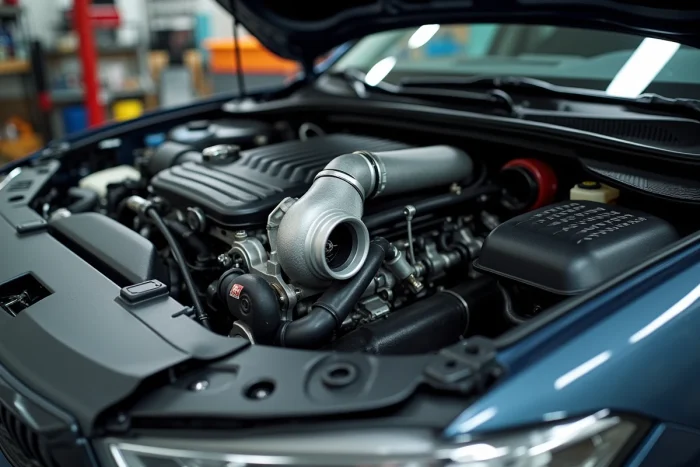
The engine ECU manages several parameters in real-time: turbo boost pressure, amount of fuel injected, ignition timing, EGR management. Manufacturers program these values with comfortable safety margins, designed to cover all operating conditions (altitude, extreme heat, variable quality fuel).
During a stage 1, a tuner connects a diagnostic tool to the vehicle’s OBD port, reads the original mapping, and then rewrites it. The modifications mainly focus on turbo pressure and injection. On a gasoline or diesel turbo engine, these adjustments release a surplus of power and torque that the manufacturer had intentionally limited.
You can also learn about stage 1 engine remapping on Auto Concept to concretely visualize the modified parameters according to each type of engine.
A point often misunderstood: on a naturally aspirated engine (without turbo), the gains are significantly more modest. The software margin for adjustment directly depends on the presence of a turbocharger. A naturally aspirated four-cylinder will not react the same way as a turbo diesel engine, even with the best mapping in the world.
Insurance and technical inspection: the real risks of stage 1
Most online guides detail the power gains. Fewer explain what happens in the event of a claim or during a technical inspection. This is where engine remapping can become costly.
Insurance: non-declaration can void compensation
Since 2022-2023, several French insurers have included undeclared engine remapping in their exclusion clauses. Even a reversible stage 1 can pose problems. In the event of an accident, an electronic inspection of the ECU is enough to detect a modified mapping.
Article L113-2 of the Insurance Code requires the driver to declare any modification to the insured risk. A remapping increases the vehicle’s power: it modifies the risk. Concrete cases of denied compensation have been reported by the Insurance Mediation (2023 report) and documented by UFC-Que Choisir in its auto claims files.
Technical inspection: stricter OBD checks
The amended decree of October 13, 2021, transposing the implementing regulation (EU) 2019/621, has tightened anti-fraud checks via the OBD port. Some centers now report remappings that disable pollution control functions (EGR, DPF, AdBlue), even if the vehicle still passes opacity tests. The risk of a re-inspection or mention on the report has significantly increased.
In practice, a stage 1 that only adjusts turbo pressure and injection without touching pollution control poses fewer problems than a stage 1 combined with DPF removal. The boundary between the two is not always clear in commercial offers: ask the tuner explicitly about it.
Stage 1 remapping: precautions before entrusting your vehicle
Not all tuners work the same way. Some use generic downloaded mappings, while others develop their own files on a dynamometer. The difference is measured in reliability and engine longevity.
Before making an appointment, check these points:
- Does the tuner have a dynamometer to measure real gains before and after modification, or do they only perform a quick flash without verification?
- Is the mapping specifically developed for your engine type, or is it a generic file resold identically for multiple models?
- Is the return to the original mapping guaranteed and included in the service, at no extra cost?
- Does the tuner check the mechanical condition of the vehicle (turbo, injectors, clutch) before intervening on the ECU?
An engine with a worn turbo or clutch will not handle an increase in torque. Increasing pressure on a fragile component accelerates failure. A good tuner will refuse to intervene if the mechanical condition does not allow it.

Flash counter and manufacturer protections: detection is improving
Do you think that returning to the original mapping is enough to erase all traces? Manufacturers have anticipated this strategy. On recent ECUs (Euro 6d standards and beyond), “tuning protection” mechanisms record each rewriting operation in an internal log.
Volkswagen-Audi (MG1/MD1 ECUs), BMW, and Stellantis use flash counters and encrypted logs that retain the history of modifications. Even after a stock return, the dealer can see that the ECU has been flashed. This information can serve as a reason to deny warranty coverage.
For a vehicle still under warranty, stage 1 remapping thus represents a gamble: the immediate power gain against the potential loss of manufacturer coverage on the powertrain.
Stage 1 on diesel or gasoline engines: different reactions
On a turbo diesel block, stage 1 primarily affects low-end torque. The engine pushes harder from the first accelerations. Fuel consumption may slightly decrease during gentle driving, because the driver uses less throttle to achieve the same response.
On a turbo gasoline engine, the gains are distributed between torque and power at the top of the RPM range. The throttle response becomes sharper, and the acceleration more pronounced. However, sporty driving after remapping can increase fuel consumption.
In both cases, the result depends as much on the quality of the mapping as on the driving style adopted afterward.
Stage 1 engine remapping remains the most accessible intervention to gain performance without opening the engine. The gain is real on a turbo vehicle in good mechanical condition. The trade-offs are just as significant: compromised manufacturer warranty, insurance to notify, more vigilant technical inspection. A well-executed stage 1 protects the engine, a poorly done stage 1 damages it.