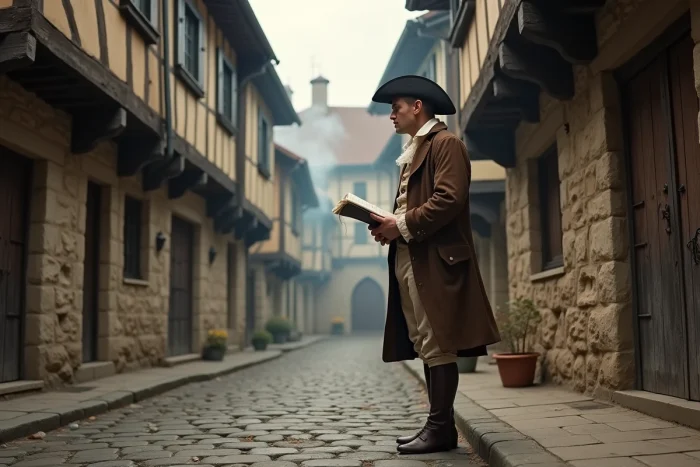
In 1720, the city of Rennes nearly disappeared in flames, permanently disrupting its urban organization and daily life. This upheaval not only changed the appearance of the neighborhoods but also led to the emergence of new practices, unprecedented laws, and collective initiatives rarely documented elsewhere in France at the same time. The imprint of this period can still be found today in the layout of the streets, the architecture, and local traditions. Some urban peculiarities directly stem from the choices made in the wake of this crisis, leaving a lasting mark on the memory and identity of the city.
Rennes in 1720: a city shaken by the great fire
On December 23, 1720, everything trembles: a spark in the workshop of the carpenter Boutrouel, and the entire city becomes the scene of an unprecedented fire. Eight hundred houses go up in smoke, entire streets turn to rubble, leaving a stunned population amidst the ruins. Yet from this ordeal arises a new momentum. Jacques Gabriel, the king’s architect, steps in with a radical project: straight axes, vast squares, a break from the old medieval mazes. The face of Rennes changes, landmarks shift, and an unexpected modernity takes hold. Walking these avenues today is to grasp the traces of a rebirth still present in the very fabric of the city, and to delve deeper, one only needs to discover the history of Rennes 1720.
What secrets and emblematic places still testify to this history?
The catastrophe of 1720 does not fade away; it leaves its mark on daily life. At the corner of Rue du Chapitre, preserved wooden beams stand alongside the sober facades resulting from the reconstruction: here, an urban patchwork confronts the old and the new, producing a landscape that is both surprising and authentic. In Place Champ-Jacquet, the winding curves of the old houses neighbor the strict alignment of the post-fire buildings; this visual dialogue embodies the memory of shock and the patience regained.
The journey continues through must-see monuments: the Parliament of Brittany rises with its massive silhouette, a sign of a need for stability. The Town Hall, the Saint-Pierre Cathedral, and the Saint-Yves Chapel, each in their own way, testify to the desire to bring forth the new without erasing the original foundations.
Several stops stand out to closely approach this history:
- The Brittany Museum presents objects, engravings, and documents that bring to life the dark days of the fire and the collective energy of reconstruction.
- The Fine Arts Museum gathers works, sketches, and visual narratives around the urban upheaval, the construction sites, and the solutions adopted after the disaster.
Visiting these places is to choose to trace the thread of centuries through survivals and rebirths, exploring concrete stories where every detail matters.

From memory to experience: how to discover today the living heritage of Rennes
The new plan drawn up after the disaster is visible everywhere: long straight roads that still intersect with old alleys, strong contrasts between past and renewal. This memory invites itself out of the museums and into the city itself, provided one walks with their head up, observes the light on the stone, and reads the details where others pass by without stopping.
To weave this connection, several addresses provide concrete insights:
- The Brittany Museum, at Champs Libres, illuminates the evolution of the urban fabric after the tragedy through models, testimonies, and period objects.
- The Science Space, nearby, offers a focused look at the transformation of water management, new risks, and the inventiveness of 18th-century builders.
But the legacy of this period is embodied as much in discreet infrastructure as in grand facades:
- The Gallets Reservoir, designed by Martenot, symbolizes the new priority given to safety. Invisible at first glance, it retains the trace of the concern for supply and anticipation that the crisis has imprinted on the functioning of the city.
Ending the stroll also means choosing a stop at the Thabor or Gayeulles park. Under the century-old trees, one savors the regained serenity of a city put to the test and reinvented. Gardened in the wake of renewal, these spaces remind us that Rennes does not simply endure the blows of fate: it integrates them, elevates them, and continues to invite surprise. Here, the light holds all the promise of a city that moves forward, without denying its scars or its boldness.