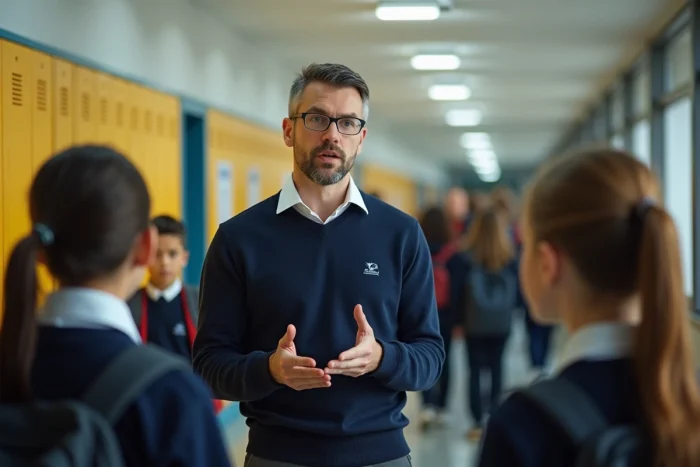
1,800 euros: not a cent more, even after several years of walking the halls. This is the harsh reality of the educational assistant contract, often renewed year after year without a promise of stability. The hours, on the other hand, are fragmented according to the schedules. We talk about precariousness, but also about a unique entry point for candidates from elsewhere, students seeking income or adults in the midst of a professional shift. And then, there is everything that is not written on a job description: supporting, defusing, listening, calming. Every day, the field imposes its own rules, far beyond the regulations displayed in the lobby.
Supervisor in middle or high school: a job at the heart of school life
In study halls, under the gaze of students coming in and out, the school supervisor, also known as an educational assistant (AED) or “pion,” occupies a strategic position. They ensure that collective rules are respected, supervise movements, and intervene when tensions rise. The job attracts diverse profiles, often students or those in career transition, who find themselves at the very center of school life.
On a daily basis, the supervisor works hand in hand with the principal education advisor (CPE), as well as teachers, the head of the institution, AESH, and families. They sometimes support students with disabilities, lead educational or sports workshops, and must manage, at any moment, a dispute or an emergency. The responsibility goes far beyond mere presence: it is necessary to ensure safety and maintain a calm atmosphere in the institution.
But behind this central role lie sometimes difficult conditions: precarious contracts, part-time hours, modest pay, and fragmented schedules. Few escape this instability. Yet, the experience remains valuable: it places the AED at the heart of the French educational system, facing the challenges of youth and the realities of national education.
To better understand the contours of this profession, the advantages and disadvantages of the job of supervisor in middle or high school deserve close examination. One discovers the human richness of the position, but also the constraints related to status, salary, and organization. Versatility, listening skills, and group management then become real tools for this discreet yet essential cog in public education.
How much do you earn and what are the daily responsibilities?
The salary of a school supervisor, or educational assistant (AED), remains modest. For a 28-hour per week contract, the net amount is around 1,000 euros at the beginning of the career. Depending on the academies and working hours, the ceiling rarely reaches 1,430 euros gross per month. Contracts are almost always fixed-term, renewable without exceeding six years in the public sector. Permanent contracts remain the exception. This flexibility attracts students, people in career transition, or those seeking their first experience in education.
The missions go far beyond mere supervision. Here are the main responsibilities entrusted to school supervisors:
- enforce the internal regulations and ensure the safety of the group
- manage study hours and detentions
- support students with disabilities
- lead educational workshops, sports, or cultural activities
- mediate during conflicts and manage tensions
The pressure never weakens. One must know how to anticipate tensions, maintain control of a moving group, and adapt to the unexpected. Among the positive points: the rhythm softened by school holidays, the richness of human exchanges, the discovery of the behind-the-scenes of the school. But the precariousness of the contract and the limited remuneration weigh on daily life. Oscillating between authority and dialogue remains the rule: one must observe, be available, act quickly, sometimes without a safety net.
Practical tips for thriving and evolving in school supervision
Being a supervisor, in middle or high school, means accepting versatility as a compass. Most of the time, these are students or individuals in transition who take this position, attracted by a concrete and human experience. A high school diploma is sufficient to apply, although some institutions expect more. What matters most: demonstrating fair authority, knowing how to listen, and managing a group.
To feel comfortable on a daily basis, it is essential to acquire a good understanding of how school life operates: managing absences, participating in the implementation of educational projects, or mastering digital tools for tracking schedules or incidents. Mediation and responsiveness are skills that make a difference, especially when tensions rise among students. Working as a team, with the CPE, the head of the institution, or AESH, also structures the day.
The job opens pathways to other professional horizons, notably:
- preparing for national education competitions (CAPES, primary school teacher)
- orienting towards animation, mediation, or specialized support (AESH, early childhood educator)
Every experience counts: supervising an activity, managing an unexpected situation, contributing to educational cohesion. Investing in collective projects, expanding one’s professional network, or obtaining certifications (BAFA, PSC1) facilitates access to other opportunities. Being a supervisor is not just a temporary position: it is an opportunity to reveal listening skills, initiative, and adaptability that make a difference in the world of education. And those who have crossed the yard, whistle in hand or notebook in pocket, know how much each day can change the game, for the students as well as for themselves.